Posted by: Edward | December 22, 2009

Some people don’t want you to change

This is not the most uplifting of posts perhaps, but if you honestly want to change your life it is important for you to realize that not everyone wants you to change. There are people in your life, even people who care for you deeply, that simply don’t want you to change.

Now… everyone has their own issues with change. Any time the situation changes people have to learn how to deal with it, so there will always be a natural resistance to change from most people.

Beyond that though, there are people who have even stronger motivations to resist your change. These people who don’t want you to change come down to two main categories. People who benefit from who you have been and people who don’t want to change themselves.

People who benefit from who you have been, may or may not be aware that this is why they are resisting your change. They may not be aware that who you have been has allowed them to take advantage of you in some way. Regardless of whether they are aware of why, these people will work hard to stop you from changing.

People who don’t want to change themselves see your changing of yourself as a statement about their inability to change. The truth is that at some level they have recognized their need to change but don’t feel that they can, or perhaps that they should have to change. “Who do you think you are? You think you’re better than me?” Often these people will surround themselves with people with problems similar to their own.

Change is hard enough without people telling us that we can’t, or otherwise making it any harder. So what can we do to mitigate this extra stress?

First, find people who DO want you to change and believe you can. Find people who will help you, and cheer for you. Any time the people who don’t want you to change, or don’t believe you can change, get you down… talk to one of your change fans.

Limit your exposure to the anti-change signals. This can mean avoiding the persons involved, or if that’s not possible for you at least don’t discuss your change process with people that oppose it. People accept things much easier once they are done. You can always spend more time with these people once you’ve made the changes you want to make.

Optionally, you could make sure that when you talk to the change resistors you make sure to explain it in such a way it doesn’t threaten their reasons for resisting your change. It might be a good idea to frame the discussion this way the first time it comes up but most of the time, avoiding the topic is the better route.

PS

Are you looking to change your life? I’d love to help you any way I can. Direct any and all inquiries to coaching [at] edwardewilson [dot] com.

Posted by: Edward | December 21, 2009

Weakness is Strength… when you learn from it

Every so often I hear about how someone isn’t qualified to help others because they have had personal problems. This doesn’t make any sense. Largely they are qualified to help BECAUSE of their history of problems.

Who has been the most successful at helping alcoholics recover? Other alcoholics.

Have I had personal problems? You bet I have. Chances are if you have a problem, I’ve already had it. I’ve had depression issues, phobia issues, relationship issues, career issues, self-esteem issues, school issues, etc. I’m not hiding these things. My failings are my resume.

Of course merely having problems isn’t ENOUGH to qualify someone to help you. The next thing they need to have done is LEARNED from it. What have they learned about coping with, or solving the problem that you have? Even someone only slightly ahead of you on the recovery curve can help you.

Next, they have to be able to communicate their learnings to you. It doesn’t matter how clever their solution for your problem is, if they are unable to explain it to you in a way you can use.

Last, they have to be willing to help you with your issues. Some people found their issues so traumatic at the time, that even though they have solved them now they aren’t willing to think or talk about them. And I respect that decision, but I don’t expect them to be able to help me.

Everything that I’m good at now, is because I used to be bad at it. Heck, when I was a baby I didn’t know how to talk, walk, or go to the bathroom by myself. Chances are… this is true of you as well.

PS

If you feel that what I’ve learned from my resume of failings could help you, direct any and all inquiries to coaching [at] edwardewilson [dot] com.

Relationship Debugging

Your relationships are some of the most important things in your life and when they are troubled it can affect every other aspect of your life. I help you clean up the channels of communication to get more pleasing and fulfilling relationships for everyone involved.

Creative Process Coaching: From Concept to Draft

Do you have an idea burning to be expressed? A dream project that you just don’t know how to start? I can help you chart the course from concept to draft, help you build a method to create and express that idea.

Captivate your Audience: Build a Community, Tell your story

Social Media has opened up a wide plain of new ways to communicate with your clients and audiences and I can help you find a way to bootstrap that process.

Life Transition Coaching

Going through a major life transformation and feeling bewildered, befuddled and maybe a little afraid? I can help you get a handle on your emotions, survey this new territory and create a vision of the future you want.

Social Confidence Coaching

Do you want to have a more active social life but find yourself getting overwhelmed? I’ll help you build the skills and locate the opportunities you need to meet and connect with new and interesting people.

Custom Solutioning

Got a problem not addressed above? I’ll give you a half hour free session and we’ll see if I can’t come up with a custom plan for working on it.

PS

Direct any and all inquiries to coaching [at] edwardewilson [dot] com.

I moved recently. The act of moving forced me into a position of rethinking how I have been living my life in terms of Who I am and Where I am. The simple fact that I am in a new environment required that I change how I act to maintain congruence between my self and my environment

This lead me to the idea of CASE. CASE is the congruence of your action, self and environment. By examining and adjusting how your actions express yourself in relation to the contextual environment you are in you increase your effectiveness and reduce stress.

No matter where you are it takes place in the context of an environment of other factors. This extends from where you live and work to social media environments like twitter and facebook. As the environment you are acting within changes, different actions become appropriate and effective. It’s not a good idea to act in a bank like you do in a bar.

Congruence is a kind of balanced matching between elements. When your action is congruent it fits, it fits with you and it fits with where you are. There are different ways to congruence but however you do it, your actions get easier and more effective.

I’m thinking about self primarily in terms of capabilities and desires. What are you trying to acheive and what are you capable of doing towards those ends? If you aren’t taking these factors into account you’ll never really be congruent, you’ll be subsumed in your environment. People do this all the time at work. They’ve adapted to their jobs but forgotten why they are working there.

Of course, the key to this is your actions. It is through your actions that you express yourself and your intentions. It is your actions that must be adapted to pursue those intentions in terms that fit the environmental context.

When I moved my actions had to change. The resources available to me had changed. But the move provided another opportunity. It allowed me a context where it made sense to think about how my actions reflected what I wanted, where I was and whether there was congruency between these factors.

But you don’t need to move to get the same opportunity. Just take a moment to think about the environments you act in, and what you want, and whether your actions encourage congruency between these things or incongruency.

PS

I can help you apply this in your work or personal life. And will do so for money. Email me at coaching [at] edwardewilson [dot] com with any inquiries.

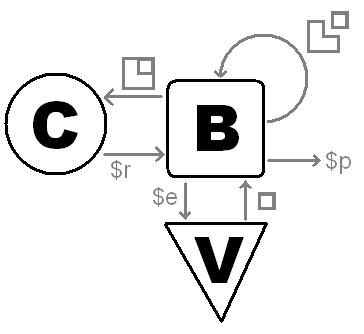
This is a system map of the basic components that constitute the world of a business. It abstracts from many on going and single instance interactions a stable pattern of relationship. This can be used for workflow analysis and strategic planning.

The components of the system: the business, the customer, and the vendor

This system map achieves its usefulness by collapsing all of your customers and vendors into the abstraction of the customer and the vendor. It can do that because the relationship between you and all of your customers is structurally the same no matter how different those interactions are at a content level. The same goes with your vendors.

The downstream flow: parts, fulfillment, and deliverables

The customer wants a deliverable, this can be a product or a service. This is something they desire enough to pay someone else to complete it for them. The business takes the parts from the vendor puts them together as a fulfillment the customer’s desire and hands them a deliverable.

The upstream flow: revenue, profit and expenses

Revenue is that money you get from your customers. Expenses is that money you pay to your vendors. Profit is where money leaves the system. Revenue minus Expenses equals profit. Once you have profit you can pay dividends or reinvest it in your business machine.

PS

I can apply this map to analyze almost any business. And will do so for money. Email me at coaching [at] edwardewilson [dot] com with any inquiries.

Posted by: Edward | November 8, 2009

Skill Upgrading

Every activity you participate in your day to day life is constructed of a series of skills that you have. If you want to improve that activity, you need to improve the specific skills that form it. This can be done with almost any activity. For example, I break running down into things like cruise speed, cruise time, recovery time, breath control, stride length. When I go for a run I concentrate on one aspect to improve it.

The first step is to go through your normal experience of it and figure out what the component skills are. Once you’ve analyzed the activity into its basic skills its simply a matter of skill drilling.

If the subskill can be practiced separately from the rest of the activity then you can practice that skill directly. If, on the otherhand, the skill can only be practiced as part of the whole activity then you simply concentrate on improving that aspect of the activity while you go through it. Don’t be worried if other aspects of the larger activity suffer while you are concentrating on a specific sub skill, that’s normal.

You should concentrate on each of the subskills in turn and then practice the activity as a whole to integrate the components into one larger skill. If you are serious about improving your performance at the activity you can make this skill upgrading a continual cycle, analyzing what components you need to work on, skill drilling and then integrating the activity again. You are only 10,000 hours away from mastery.

If you like this article feel free to give it a thumbs up on stumbleupon.

Posted by: Edward | September 7, 2009

The Maxx and Trauma Therapy

“The Maxx is an American comic book and animation character created by Sam Kieth and published by Image Comics. The comic book spawned an animated series that aired on the MTV network” (Wikipedia, The Maxx).
This piece is based on the MTV animation.
The Maxx is a fascinating fictional exploration of deep trauma therapy, about facing ourselves and having the courage to grow.
The Maxx himself is a projection of Julie’s defense, the mask, over her trauma, the rabbit.
Other therapeutically useful elements that The Maxx presents is The Outback, which is a person’s unconscious territory or dreamscape; a power animal, which guides a person towards growth; a heroic or mythic self, in Julie Winters’s case it is The Leopard Queen and finally, an inner child fixed before/at the moment of trauma.
Julie starts to heal when she makes contact with child-Julie it her sacred space. This is a space where The Maxx, her trauma and defense, can’t exist.
The Maxx also shows that the trauma doesn’t have to be some kind of abuse but rather is a situation that the person just can’t cope with  at their present level of development. That experience is then encoded in their defense and on a certain line of development they remain fixed, continually acting out the trauma in its encoded form.
By putting the parts of the trauma/defense system in communication with each other that system begins to break down and from that comes breakthrough.

The Maxx is an American comic book and animation character created by Sam Kieth and published by Image Comics. The comic book spawned an animated series that aired on the MTV network” (Wikipedia, The Maxx).

This piece is based on the MTV animation.

The Maxx is a fascinating fictional exploration of deep trauma therapy, about facing ourselves and having the courage to grow.

The Maxx himself is a projection of Julie’s defense, the mask, over her trauma, the rabbit.

Other therapeutically useful elements that The Maxx presents is The Outback, which is a person’s unconscious territory or dreamscape; a power animal, which guides a person towards growth; a heroic or mythic self, in Julie Winters’s case it is The Leopard Queen and finally, an inner child fixed before/at the moment of trauma.

Julie starts to heal when she makes contact with child-Julie it her sacred space. This is a space where The Maxx, her trauma and defense, can’t exist.

The Maxx also shows that the trauma doesn’t have to be some kind of abuse but rather is a situation that the person just can’t cope with  at their present level of development. That experience is then encoded in their defense and on a certain line of development they remain fixed, continually acting out the trauma in its encoded form.

By putting the parts of the trauma/defense system in communication with each other that system begins to break down and from that comes breakthrough.

If you like this article feel free to give it a thumbs up on stumbleupon.

Posted by: Edward | August 13, 2009

The Magic of Nonviolent Communication

The NonViolent communication process is deceptively simple but holds within it a key to aligning our actions with our feelings and desires.
The four components of the NVC process are observations, feelings, needs, and requests. Primary ideas of NVC are to separate observation from judgment, to own the emotions involved, to connect to the needs that drive them and to ground them in a specific request or action.
In it’s simplest form an NVC statement would be as follows: When (observation), I feel (feeling) because I need (need). Do you think you could (request)? When dealing with your own thoughts you could translate any thought into a similar structure. When (observation), I feel (feeling) because I want (desire). So I’m going to (action).
The four components are compatible with a four element model of magic. Observation is air, feeling is water, need is fire, and request is earth. The action of separating our experience and message this way is performing the actions of Solve et Coagula. The when the elements of the experience are mixed it is harder to be conscious of them. By consciously separating the experience into phased elements each one is experienced cleanly for itself and then reunited as an action or request.
Even if this process had no effect on other people I feel it would be worthwhile just for the way it creates alignment between our feelings, needs and actions. By actively attempting to frame our communications in this matter we authentically connect with our feelings and desires. This makes it easier to respond rather than react and will increase our power.
By parsing our own experiences this way we are more authentic, which does benefit us in communicating what we want and why. By organizing other people’s experience in this manner we gain a greater sense of empathy. It is easier to come to agreement with someone if we understand how they feel and what they actually need and desire from the interaction.

The nonviolent communication process is deceptively simple but holds within it a key to aligning our actions with our feelings and desires.

The four components of the NVC process are observations, feelings, needs, and requests. Primary ideas of NVC are to separate observation from judgment, to own the emotions involved, to connect to the needs that drive them and to ground them in a specific request or action.

In it’s simplest form an NVC statement would be as follows: When (observation), I feel (feeling) because I need (need). Do you think you could (request)?

When dealing with your own thoughts you could translate any thought into a similar structure. When (observation), I feel (feeling) because I want (desire). So I’m going to (action).

When the elements of the experience are mixed it is harder to be conscious of them. By consciously separating the experience into phased elements each one is experienced cleanly for itself and then reunited as an action or request.

Even if this process had no effect on other people I feel it would be worthwhile just for the way it creates alignment between our feelings, needs and actions. By actively attempting to frame our communications in this matter we authentically connect with our feelings and desires. This makes it easier to respond rather than react and will increase our power.

By parsing our own experiences this way we are more authentic, which does benefit us in communicating what we want and why. By organizing other people’s experience in this manner we gain a greater sense of empathy. It is easier to come to agreement with someone if we understand how they feel and what they actually need and desire from the interaction.

Rosenberg, Marshall B. Nonviolent Communication: A Language of Compassion. PuddleDancer Press: 2002.

If you like this article feel free to give it a thumbs up on stumbleupon.

Posted by: Edward | July 8, 2009

How to Remember Names

Almost everyone seems to have a problem remembering names. This is something that I’ve become much better at over the last year. As I’ve said to people who have asked me why I’m so good at remembering names, I’m good at it because I used to be so bad at it. I made a decision that I would get much better at remembering people’s names. What follows are some of my tricks and tips to improving your name memory.
That’s the first step, making remembering of names very important for you. I was just coming out of a relationship and I was meeting a lot of new people in a context where I’d see a lot of them again. Remembering their names was a key part of integrating into that social context. I made sure to ask people’s names, to re-ask if I forgot and to use their names as much as possible. If I were to see them again I would attempt to use their name, even when I wasn’t sure.
You can always pre-frame an attempted remembering by making it a half question. For example, “I’m really bad with names, was your name Sandy?” If you are right they’ll be happy, if you are wrong they’re usually happy you tried and will correct you. Almost everyone has had the experience of having trouble with other people’s names so people tend to be very understanding and helpful when things are framed this way.
The next thing I do is visualize the person’s name just above their head. I see it a bit like an old computer game with the characters name in a box above their head. Other people visualize a hello-my-name-is name tag on their forehead. I’ll visualize their name above their head and take a mental snapshot of the now labeled face. We remember faces easier than names in part because most people have an easier time with visual recall than auditory.
To enrich this visual cue, you can also say their name again and this time, feel how your mouth moves when saying it. Try to connect the sight, the sound, and the feeling together. This might be weird the first few times you do it but it can become second nature after a while. By connecting all three senses together the neurological representation of the person and their name is very rich and you have much greater odds of recalling it.
Then I work on creating vivid associations with this person and their name. The more things you remember that the persona and name are associated with the more tied into your memory they become. I aim to connect their name to six things as a minimum. You could connect them to the context where you met them, mutual acquaintances, shared interests, what they do for a living, the meaning of their name, etc. The richer and more varied each of those associated bits are, the better. I like to visualize an image of each of those associations connected to their name a bit like a mind map.
After meeting someone a brief review of what you know about them, or what you associate with them, can vastly improve your later recall of their name. After I got to something where I meet a lot of new people I like to run through who I met and what was interesting about each of them just to solidify them in my head.
The last little trick I do is the circle of names. Basically when you are meeting with a group of people  I go through and say, out loud or in my head depending on appropriateness, the name of everyone in order of where they are positioned in space. I usually go around clockwise. This connects spatial organization and ordering to the memories. Everyone is linked to the people on either side of them and by their position in the whole group.
With those four tactics making names important to you, visualizing their name, building rich associations and the circle of names, I vastly improved my ability to remember people’s names. And so can you. Try them out and let me know how it works for you. Feel free, also, to share your best trick for remembering names in the comments.

Almost everyone seems to have a problem remembering names. This is something that I’ve become much better at over the last year. As I’ve said to people who have asked me why I’m so good at remembering names, I’m good at it because I used to be so bad at it. I made a decision that I would get much better at remembering people’s names. What follows are some of my tricks and tips to improving your name memory.

That’s the first step, making remembering of names very important for you. I was just coming out of a relationship and I was meeting a lot of new people in a context where I’d see a lot of them again. Remembering their names was a key part of integrating into that social context. I made sure to ask people’s names, to re-ask if I forgot and to use their names as much as possible. If I were to see them again I would attempt to use their name, even when I wasn’t sure.

You can always pre-frame an attempted remembering by making it a half question. For example, “I’m really bad with names, was your name Sandy?” If you are right they’ll be happy, if you are wrong they’re usually happy you tried and will correct you. Almost everyone has had the experience of having trouble with other people’s names so people tend to be very understanding and helpful when things are framed this way.

The next thing I do is visualize the person’s name just above their head. I see it a bit like an old computer game with the characters name in a box above their head. Other people visualize a hello-my-name-is name tag on their forehead. I’ll visualize their name above their head and take a mental snapshot of the now labeled face. We remember faces easier than names in part because most people have an easier time with visual recall than auditory.

To enrich this visual cue, you can also say their name again and this time, feel how your mouth moves when saying it. Try to connect the sight, the sound, and the feeling together. This might be weird the first few times you do it but it can become second nature after a while. By connecting all three senses together the neurological representation of the person and their name is very rich and you have much greater odds of recalling it.

Then I work on creating vivid associations with this person and their name. The more things you remember that the person and name are associated with, the more tied into your memory they become. I aim to connect their name to six things as a target. You could connect them to the context where you met them, mutual acquaintances, shared interests, what they do for a living, the meaning of their name, etc. The richer and more varied each of those associated bits are, the better. I like to visualize an image of each of those associations connected to their name a bit like a mind map.

After meeting someone a brief review of what you know about them, or what you associate with them, can vastly improve your later recall of their name. After I got back from something where I meet a lot of new people I like to run through who I met and what was interesting about each of them just to solidify them in my head. Reviewing twice, once after meeting and once after leaving helps.

The last little trick I do is the circle of names. Basically when you are meeting with a group of people  I go through and say, out loud or in my head depending on appropriateness, the name of everyone in order of where they are positioned in space. I usually go around clockwise. This connects spatial organization and ordering to the memories. Everyone is linked to the people on either side of them and by their position in the whole group.

With those four tactics, making names important to you, visualizing their name, building rich associations and the circle of names, I vastly improved my ability to remember people’s names. And you can too. Try them out and let me know how it works for you. Feel free, also, to share your best trick for remembering names in the comments.

If you like this article feel free to give it a thumbs up on stumbleupon.
Posted by: Edward | June 24, 2009

The Four NLP Meta Skills

Meta skills are skills about other skills. These are the skills that form a foundation that other NLP learning is based on. The meta skills are abstract and are like a particular way of organizing your more direct skills. If you have the meta skills, acquiring sub-skills will be easier and more focused. Mastering the meta skills is a major landmark on the path to NLP mastery.
Outcome Focus
Outcome focus is going into any situation or interaction knowing what you want out of it. It is having a clear and positive intention for the interaction.If you don’t know what you want how will you know if you get it? With out this the rest falls apart. The main thing in order to get it is to think before any given interaction, what do I want from this? The next thing is to apply the wellformedness conditions for desired states. They are in brief the goal must be stated in the postitives, initiated and maintained by the person who desires it, defined and evaluated according to sensory based evidence, made to perserve the positive by-products of the present condition, and appropriate to fit your existing relationships. I like to make a picture, or movie, in my head of the outcome I want along with the sounds I’ll hear and the feelings I’ll feel.
Strategic Thinking
Strategic thinking is the ability to compare where you are now with where you want to get and have an idea about what to do in order to move you in that direction. Strategic thinking also involves an understanding of the larger process leading from the starting condition to the desired outcome. Having strategic thinking makes the process of leading situations towards your desires more directed and effective. To get strategic thinking, first you want to have your various behaviour patterns trained into unconscious competence so you don’t have to think about them. Next, you want to unpack the larger structure of what is being presented to your sensory acuity. You are building a model of that larger structure in your head. Then you compare what you are being presented with your desired outcome. Finally, with your understanding of the larger structure try a technique that might move the situation in the direction you want.
Sensory Acuity
Sensory acuity is training your senses to pick out of whatever situation you are in that which is useful to you. Having sensory acuity allows you to get the information you need from people’s communications and allows you to experience things more fully. It is a vital component of knowning if you are getting the response you want. You get sensory acuity by learning what to pay attention to. For example, learning to sort for incongruities, eye accessing cues and tonality shifts.
Behavioral Flexibility
Behavioral flexibility is having a lot of options for the actions you can take and being able to switch tactics easily and smoothly. Having behavioural flexibility allows you to more easily get to the results you want. If something you try doesn’t work, you can simply try something else. You get behaviour flexibilty by learning many skills to the point of unconscious competance and bing willing to jump in and try things. The more patterns you are comfortable using with unconscious competance, the more flexible you can be.

Meta skills are skills about other skills. These are the skills that form a foundation that other NLP learning is based on. The meta skills are abstract and are like a particular way of organizing your more direct skills. If you have the meta skills, acquiring sub-skills will be easier and more focused. Mastering the meta skills is a major landmark on the path to NLP mastery.

Outcome Focus

Outcome focus is going into any situation or interaction knowing what you want out of it. It is having a clear and positive intention for the interaction.If you don’t know what you want how will you know if you get it? With out this the rest falls apart. The main thing in order to get it is to think before any given interaction, what do I want from this? The next thing is to apply the wellformedness conditions for desired states. They are in brief the goal must be stated in the postitives, initiated and maintained by the person who desires it, defined and evaluated according to sensory based evidence, made to perserve the positive by-products of the present condition, and appropriate to fit your existing relationships. I like to make a picture, or movie, in my head of the outcome I want along with the sounds I’ll hear and the feelings I’ll feel.

Strategic Thinking

Strategic thinking is the ability to compare where you are now with where you want to get and have an idea about what to do in order to move you in that direction. Strategic thinking also involves an understanding of the larger process leading from the starting condition to the desired outcome. Having strategic thinking makes the process of leading situations towards your desires more directed and effective. To get strategic thinking, first you want to have your various behaviour patterns trained into unconscious competence so you don’t have to think about them. Next, you want to unpack the larger structure of what is being presented to your sensory acuity. You are building a model of that larger structure in your head. Then you compare what you are being presented with your desired outcome. Finally, with your understanding of the larger structure try a technique that might move the situation in the direction you want.

Sensory Acuity

Sensory acuity is training your senses to pick out of whatever situation you are in that which is useful to you. Having sensory acuity allows you to get the information you need from people’s communications and allows you to experience things more fully. It is a vital component of knowning if you are getting the response you want. You get sensory acuity by learning what to pay attention to. For example, learning to sort for incongruities, eye accessing cues and tonality shifts.

Behavioral Flexibility

Behavioral flexibility is having a lot of options for the actions you can take and being able to switch tactics easily and smoothly. Having behavioural flexibility allows you to more easily get to the results you want. If something you try doesn’t work, you can simply try something else. You get behaviour flexibilty by learning many skills to the point of unconscious competance and bing willing to jump in and try things. The more patterns you are comfortable using with unconscious competance, the more flexible you can be.

If you like this article feel free to give it a thumbs up on stumbleupon.

« Newer Posts - Older Posts »

Categories